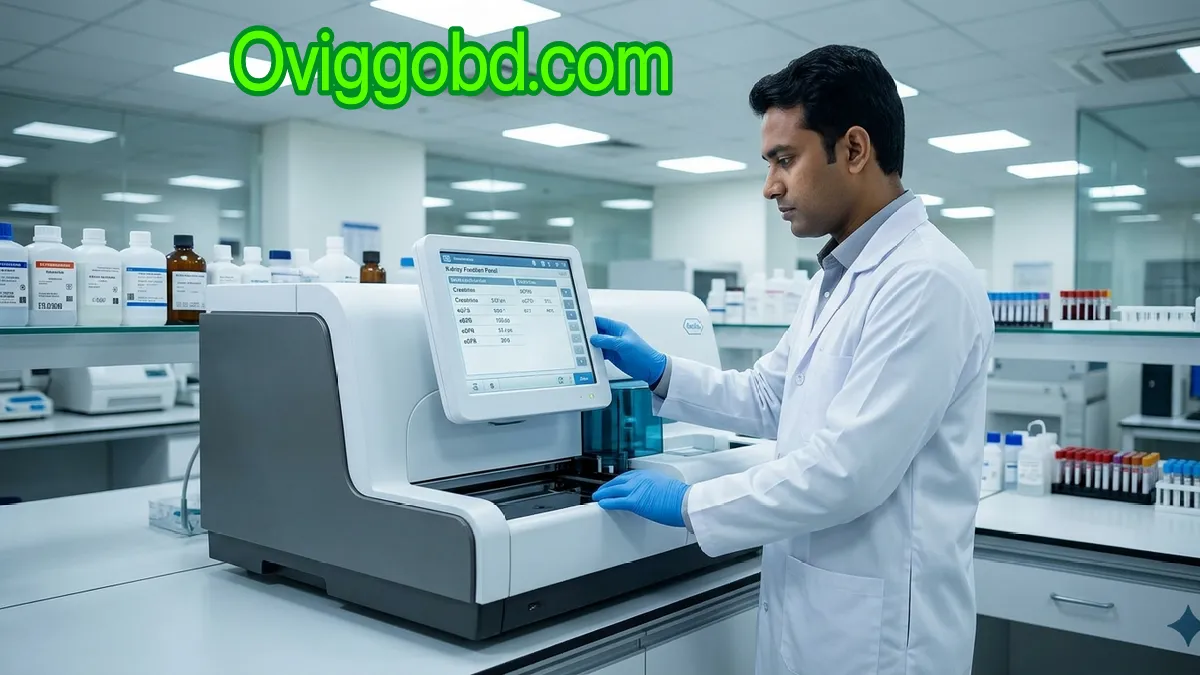
For anyone managing diabetes, hypertension, or a family history of kidney disease, understanding the eGFR test price in Bangladesh is the first practical step toward protecting long-term renal health. The estimated Glomerular Filtration Rate (eGFR) is the most reliable and clinically validated marker of kidney function currently available in routine diagnostic practice. It estimates the volume of blood the kidneys filter per minute, adjusted for body surface area, and is reported in millilitres per minute per 1.73 m² (mL/min/1.73 m²). Because chronic kidney disease (CKD) is almost entirely silent in its early stages — producing no pain, no obvious symptoms, and no warning — the eGFR test serves as an indispensable tool for early clinical evaluation and timely intervention before irreversible renal damage occurs.
Bangladesh carries a significant and growing burden of CKD, driven primarily by the high prevalence of type 2 diabetes and hypertension in the general population. Routine eGFR testing is therefore not a luxury — it is a cornerstone of preventive nephrology care.
How eGFR Is Calculated: The CKD-EPI 2021 Equation
The eGFR is not measured directly. It is estimated by a validated mathematical formula applied to the serum creatinine result. The current international gold standard is the CKD-EPI 2021 (Chronic Kidney Disease Epidemiology Collaboration) equation, which uses three inputs: serum creatinine concentration, the patient’s age, and biological sex.
Notably, the 2021 revision removed race as a variable — a significant improvement that corrects a prior systematic overestimation of kidney function in Black patients and reduces health disparities. This updated formula is endorsed by the National Kidney Foundation (NKF), the American Society of Nephrology (ASN), and the KDIGO 2024 Clinical Practice Guidelines as the recommended first-line method for estimating GFR in adults aged 18 and older.
Many Bangladeshi laboratories still report eGFR using the older MDRD (Modification of Diet in Renal Disease) formula. Patients should note which equation their lab uses, as this can affect result interpretation, particularly at higher eGFR values.
Table of Contents
eGFR vs. Serum Creatinine: What Is the Difference?
Serum creatinine is the raw measurement — a waste product generated by muscle metabolism and filtered by the kidneys. eGFR is the interpreted value — a calculation that contextualises the creatinine level against the patient’s age and sex to produce a standardised estimate of kidney filtering capacity.
A serum creatinine result alone can be misleading. An elderly woman with a creatinine level of 1.0 mg/dL may actually have a significantly impaired eGFR due to her naturally lower muscle mass, while a young male athlete with the same creatinine level may have perfectly normal kidney function. This is precisely why reporting creatinine alongside a calculated eGFR — commonly offered as a combined “Serum Creatinine with eGFR” panel — represents the current standard of clinical care.
eGFR Test Price in Bangladesh: Updated 2026 Cost Guide
The table below presents the most current available pricing for the eGFR test and associated creatinine panels at major diagnostic centres across Bangladesh. Prices are approximate and subject to change; always confirm the current rate directly with the diagnostic centre before visiting.
Instant Answer Box — eGFR Test Price at a Glance
| Diagnostic Centre | eGFR / Creatinine with eGFR Test Price (BDT) | Notes |
|---|---|---|
| Popular Diagnostic Centre | ৳1000 – ৳1400 | Price may vary by branch; includes serum creatinine |
| Ibn Sina Diagnostic Centre | ৳350 – ৳550 | 25% standard discount applies to the listed price |
| Labaid Diagnostic | ৳400 – ৳500 | Serum creatinine with eGFR calculation |
| icddr,b Lab Services | Included in packages | Part of Kidney/Renal Function panel (package ~৳8,490) |
| BSMMU (Government) | ৳70 – ৳150 | Serum creatinine; eGFR may be calculated separately |
| General Private Labs (Dhaka) | ৳300 – ৳700 | Varies widely by location and accreditation |
| Outside Dhaka (District Labs) | ৳250 – ৳500 | Quality and methodology may vary |
Important Note: At most Bangladeshi diagnostic centres, the eGFR is not a separate billable test. It is a calculated value derived from the serum creatinine result and is reported automatically alongside it at no additional charge. When requesting this test, ask specifically for “Serum Creatinine with eGFR” to ensure the calculated value appears on your report.
eGFR Test Price in Popular Diagnostic Centre
Popular Diagnostic Centre (PDC) follows a distinct billing structure compared to most other diagnostic centres in Bangladesh — and patients should understand this clearly before visiting.
At PDC, the serum creatinine test is available at approximately ৳400 BDT, broadly in line with government-aligned reference pricing. However, when an eGFR result is required — whether requested independently or prescribed alongside creatinine by a physician — PDC bills this as a separate, higher-tier investigation.
The Serum Creatinine with eGFR panel at PDC is priced at:
- ৳1,000 BDT at the Dhanmondi head office
- Up to ৳1,400 BDT at other branches
Both the serum creatinine value and the eGFR rate appear together on a single printed report, as the eGFR is automatically calculated by the laboratory information system from the creatinine result. Patients do not receive two separate reports.
One important practical point for patients: If a physician prescribes both Serum Creatinine and eGFR on the same request slip, PDC’s billing system treats this as a single eGFR investigation and charges the higher eGFR rate — the standalone creatinine charge is not applied separately. Effectively, the eGFR test fee covers both values on the report.
Patient advisory: Always clarify the expected charge at the billing counter before sample collection. If your physician has prescribed only serum creatinine but you also need the eGFR value for clinical monitoring, requesting the eGFR test directly at PDC will ensure both values appear on your report at the stated price.
eGFR Test Price in Ibn Sina Diagnostic Centre
Ibn Sina Diagnostic & Consultation Center applies a standard 25% discount on listed rates across all its branches in Bangladesh, making diagnostic services more accessible for patients. The listed price for a serum creatinine with eGFR panel at Ibn Sina is approximately ৳350 – ৳550 after the standard discount is applied.
The eGFR (MDRD) at Ibn Sina estimates the glomerular filtration rate using the Modification of Diet in Renal Disease formula, assessing kidney function by calculating the rate at which kidneys filter waste from the blood and factoring in creatinine levels, age, sex, and race. Results are reported in mL/min/1.73m², with lower values indicating impaired kidney function.
For the most up-to-date pricing, patients should contact Ibn Sina’s hotline at 10615 or visit their official website. Ibn Sina also offers home sample collection in select locations, which may be particularly useful for elderly or mobility-impaired patients with CKD.
Serum Creatinine with eGFR Test Price in Bangladesh
The serum creatinine with eGFR test is the standard combined panel requested by nephrologists and general physicians for kidney function assessment across Bangladesh. The average cost of a serum creatinine test in Bangladesh typically ranges from BDT 800 to BDT 1,400 at larger private facilities, though many centres offer it at significantly lower rates — as low as BDT 300–400 — when the eGFR is included as a calculated add-on rather than a separate test.
Patients with diabetes, hypertension, or suspected CKD are typically advised by their physician to request the full Renal Function Test (RFT) panel, which bundles creatinine, eGFR, blood urea nitrogen (BUN), uric acid, and electrolytes into a single, cost-effective investigation package.
eGFR Test Price Comparison: All Major Diagnostic Labs
| Centre Type | Approximate Price Range (BDT) | Methodology |
|---|---|---|
| Government hospitals (BSMMU, DMCH) | ৳70 – ৳200 | Creatinine only; eGFR calculated separately |
| Large accredited private centres | ৳350 – ৳700 | Creatinine + automated eGFR calculation |
| Mid-tier private labs (Dhaka/divisional cities) | ৳250 – ৳500 | Varies; confirm eGFR is reported |
| Specialised reference labs (icddr,b) | Part of packages | Highest analytical quality |
READ MORE: Serum Creatinine Test Price in Bangladesh — Complete 2026 Guide
eGFR Normal Range: What Do Your Results Mean?
Understanding the result is as important as knowing the eGFR test price in Bangladesh. The following reference ranges and CKD staging criteria are based on the internationally recognised KDIGO (Kidney Disease: Improving Global Outcomes) 2024 guidelines.
A typical eGFR for healthy adults generally exceeds 90. It is important to note that kidney filtration naturally slows down as part of the aging process, even in the absence of any underlying renal conditions.
A normal eGFR is 60 or more. If a patient’s eGFR is less than 60 for three months or more, the kidneys may not be working well.
CKD Staging by eGFR Value (G1 to G5)
| CKD Stage | eGFR (mL/min/1.73 m²) | Kidney Function Status | Clinical Significance |
|---|---|---|---|
| G1 (Normal) | ≥ 90 | Normal or high | Kidney damage present with other markers (e.g., proteinuria) |
| G2 (Mildly decreased) | 60 – 89 | Mildly decreased | Often asymptomatic; requires monitoring |
| G3a | 45 – 59 | Mild to moderate decrease | Increased risk of cardiovascular complications |
| G3b | 30 – 44 | Moderate to severe decrease | Symptoms may begin; specialist consultation strongly advised |
| G4 (Severely decreased) | 15 – 29 | Severe decrease | Preparation for renal replacement therapy required |
| G5 (Kidney failure / ESRD) | < 15 | Kidney failure | Dialysis or transplantation required |
Interpretation note: A single eGFR result below 60 does not confirm CKD. CKD is defined as kidney damage or an eGFR less than 60 mL/min/1.73 m², persisting for 3 months or more, irrespective of the cause. Repeat testing over three months is mandatory before a diagnosis is established.
Factors That Affect eGFR Accuracy
The eGFR calculation is an estimate, not a direct measurement. Several clinical conditions can reduce its accuracy, and physicians must interpret results within the full clinical context:
- Extreme muscle mass (bodybuilders or amputees): Creatinine production deviates from average, skewing eGFR
- Severe malnutrition or cachexia: May falsely elevate eGFR by reducing creatinine generation
- Acute kidney injury (AKI): eGFR equations assume stable kidney function; values during AKI are unreliable
- Pregnancy: Physiological hyperfiltration causes eGFR to overestimate true function
- Advanced liver cirrhosis: Reduced creatinine production artificially inflates eGFR
- Certain medications: Drugs such as trimethoprim or cimetidine competitively inhibit tubular creatinine secretion, raising serum creatinine without reflecting a true reduction in GFR
For more precise results, especially when eGFR is close to a treatment decision point, physicians may order a cystatin C blood test and use the combined creatinine-cystatin C equation, which is more accurate than either marker alone.
Who Should Get an eGFR Test? Clinical Indications
Physician guidelines recommend eGFR testing for any patient with one or more of the following risk factors or clinical presentations:
- Diagnosed type 1 or type 2 diabetes mellitus — annual eGFR screening is standard of care
- Hypertension — especially when blood pressure is poorly controlled
- Recurrent urinary tract infections (UTIs) or kidney infections
- Known structural kidney abnormalities (polycystic kidney disease, single kidney)
- Family history of chronic kidney disease or hereditary nephropathy
- Systemic diseases affecting the kidney: lupus, vasculitis, multiple myeloma
- Use of nephrotoxic medications: long-term NSAIDs, aminoglycoside antibiotics, certain chemotherapy agents, contrast media
- Symptoms of uraemia: unexplained fatigue, ankle swelling, loss of appetite, itching, or reduced urine output
- Abnormal urine results: proteinuria or haematuria detected on routine urinalysis
Early identification through eGFR-based clinical evaluation enables timely nephrology referral, dietary modification, blood pressure optimisation, and pharmacological management that can meaningfully slow CKD progression.
READ MORE: Normal Creatinine Levels by Age: Complete Reference Chart & Clinical Guide (2026)
eGFR Test Price in Lal PathLabs India: A Reference for Cross-Border Patients
For Bangladeshi patients who travel to India for specialist nephrology consultations, or for comparative reference, the eGFR test price at Lal PathLabs India is a commonly searched query. Dr. Lal PathLabs is a trusted name in diagnostics across India, offering a wide range of tests with home sample collection available nationwide.
In India, the eGFR is typically reported as part of the Kidney Function Test (KFT) or Renal Profile panel rather than as a standalone test. At Lal PathLabs, the KFT panel — which includes serum creatinine, BUN, uric acid, electrolytes, and eGFR — is priced approximately in the range of ₹400 – ₹800 INR (roughly equivalent to ৳600 – ৳1,200 BDT at 2026 exchange rates), though prices vary by city, with Delhi and Mumbai typically higher than other cities.
Patients are advised to confirm current Lal PathLabs pricing directly via lalpathlabs.com or their toll-free booking line, as rates fluctuate and city-specific variations apply.
Note for Bangladeshi patients: Lab reports generated by Indian diagnostic centres are generally accepted by Bangladeshi nephrologists for clinical follow-up, provided the laboratory is accredited (NABL or equivalent certification).
How to Prepare for an eGFR Blood Test
The eGFR test requires only a simple blood draw from a vein (venepuncture), typically from the antecubital fossa (inner elbow). Preparation is straightforward:
- Fasting is not strictly required for a standalone creatinine/eGFR test. However, if the test is ordered as part of a broader metabolic or renal panel that includes fasting glucose or lipid profile, an 8–12 hour fast will be required
- Avoid intense physical exercise for 24–48 hours before the test, as strenuous activity temporarily elevates serum creatinine and may produce a spuriously low eGFR result
- Stay well-hydrated — dehydration raises creatinine levels, which can lower eGFR values and mimic mild kidney impairment
- Inform the laboratory of all current medications, including over-the-counter NSAIDs (such as ibuprofen or naproxen), as these can affect creatinine levels
- Bring a previous eGFR report if available — trend analysis over time is far more clinically meaningful than any single result
- No radiological contrast (e.g., from a recent CT scan with contrast) should have been administered within 48 hours before the test, as contrast agents can transiently impair kidney function
Sample processing typically takes 4–24 hours at accredited laboratories in Dhaka. Urgent reports may be available within 2–4 hours at some centres.
After Your eGFR Result: Specialist Consultation & Treatment Protocol

An eGFR result should never be interpreted in isolation. The result must always be contextualised with the patient’s full clinical history, comorbidities, concurrent medications, and urinalysis findings (particularly albumin-to-creatinine ratio, or ACR).
With treatment and healthy lifestyle changes, many people in Stage 3 CKD do not progress to Stage 4 or Stage 5. A timely referral to a nephrologist (kidney specialist) remains the most important intervention following an abnormal eGFR result.
The standard treatment protocol for patients with reduced eGFR typically involves several pillars of management:
Blood pressure optimisation: Target BP below 130/80 mmHg in CKD patients. ACE inhibitors or ARBs are the first-line antihypertensive agents as they have documented renoprotective effects beyond blood pressure control.
Glycaemic management in diabetic patients: HbA1c target of ≤7.0% (or as individualised by the treating physician) is essential to slow diabetic nephropathy progression. SGLT-2 inhibitors (e.g., empagliflozin, dapagliflozin) are now first-line agents in diabetic CKD due to their demonstrated kidney-protective benefits.
Dietary modification: A nephrologist-supervised renal diet — typically restricted in protein (0.6–0.8 g/kg/day in non-dialysis CKD), sodium, potassium (in advanced stages), and phosphate — is a critical non-pharmacological component of the treatment protocol.
Serial eGFR monitoring: The frequency of repeat testing depends on CKD stage. Patients with stable Stage G1–G2 may be monitored annually; those with G3b–G4 may require testing every 3–6 months to detect progression and adjust therapy.
Nephrotoxin avoidance: All NSAIDs, herbal nephrotoxins (common in traditional medicine across South Asia), and iodinated contrast agents should be used with extreme caution or avoided entirely in patients with reduced eGFR.
Early and consistent engagement with specialist nephrology care is the most evidence-based strategy to preserve residual kidney function and defer — or potentially prevent — the need for dialysis or renal transplantation.
FAQ SECTION
Q: What is the eGFR test price in Bangladesh at major diagnostic centres?
A: The eGFR test price in Bangladesh varies significantly depending on the diagnostic centre. At Popular Diagnostic Centre, the serum creatinine with eGFR panel is priced at ৳1,000 BDT at the Dhanmondi head office and up to ৳1,400 BDT at other branches — both values (creatinine and eGFR) appear on a single report. By contrast, standalone serum creatinine at PDC is approximately ৳400. At Ibn Sina, the effective price after the standard 25% discount is ৳350–৳550. Government facilities such as BSMMU offer creatinine testing from ৳70–৳150, though eGFR may not be automatically reported. Always confirm the current price at the billing counter before sample collection.
Q: What is the eGFR test price at Ibn Sina Diagnostic Centre in 2026?
A: The eGFR test at Ibn Sina Diagnostic Centre is reported as part of the serum creatinine or Kidney Function Test panel. After Ibn Sina’s standard 25% institutional discount, patients can expect to pay approximately ৳350 to ৳550 BDT. The eGFR value is automatically calculated from the serum creatinine result using the MDRD formula and appears on the printed report. For the exact current price, patients should contact Ibn Sina’s hotline at 10615 or visit the nearest branch.
Q: What is the serum creatinine with eGFR test price in Bangladesh, and are they the same test?
A: Serum creatinine is the raw blood measurement; eGFR is a value calculated from it using the patient’s age and sex. At most Bangladeshi diagnostic centres, eGFR is reported alongside creatinine at no additional charge. However, Popular Diagnostic Centre bills these differently — serum creatinine alone costs approximately ৳400, while the eGFR test (which includes the creatinine result on the same report) costs ৳1,000 at the Dhanmondi head office and up to ৳1,400 at other branches. If a doctor prescribes both tests together, PDC consolidates them under the eGFR charge. At other major centres such as Ibn Sina and Labaid, the combined creatinine with eGFR panel costs ৳350–৳500.
Q: What is the eGFR test price at Lal PathLabs in India, and how does it compare to Bangladesh?
A: At Dr. Lal PathLabs in India, the eGFR is included within the Kidney Function Test (KFT) panel, which is priced approximately ₹400 – ₹800 INR (roughly ৳600 – ৳1,200 BDT at current exchange rates), with prices varying by city. This is broadly comparable to or slightly higher than costs at major accredited private diagnostic centres in Dhaka. Bangladeshi patients undergoing cross-border consultations in India should retain original Lal PathLabs reports, as these are generally accepted by Bangladeshi nephrologists. Exact Lal PathLabs pricing should be confirmed at lalpathlabs.com

নতুন কিছু শিখতে চাই এবং সেখাতে চাই । অনভিজ্ঞও থেকে আপনিও হয়ে উঠুন অভিজ্ঞ।